
Three Predictions That Could Reshape the ServiceNow Ecosystem
The businesses that master how to govern autonomous workforces will define the next generation of enterprise transformation. And this isn’t a distant future. It’s already starting to play out.
Over the last 10 years, ServiceNow has evolved from its roots in IT service management into a strategic enterprise platform. What’s becoming increasingly clear, however, is that we’re only just starting to understand the real impact it’s having.
As the capabilities of AI accelerate, enterprise architecture is shifting to compensate, and platforms that can orchestrate, govern, and scale these changes will define the next era – and it’s looking exciting.
Based on what I’ve witnessed in the ServiceNow ecosystem over the last few years, here are three predictions that I believe they will actively reshape.
1. ServiceNow Becomes the Operating System for Enterprise Work
Most businesses today still operate with a fragmented technology stack.
ERP systems manage transactions, while CRM platforms manage customer relationships, and HR systems manage people. But how tasks move across teams, systems, and processes remains fragmented.
This is where ServiceNow has been actively positioning itself.
Rather than competing directly with ERP or CRM platforms, ServiceNow is increasingly acting as the coordinating layer across systems. Gartner defines modern IT service management and automation platforms as enabling cohesive workflow management and orchestration across systems and teams.
As AI use in business evolves from providing insight to executing tasks, businesses will need a platform that can:
- Orchestrate actions across systems
- Enforce governance and compliance
- Provide auditability of decisions
- Manage exceptions and escalations
And that prospect isn’t far from reality. According to McKinsey & Company, generative AI could automate up to 60–70% of activities across business functions, which just goes to show the scale of orchestration across the tech stack that’s required. And ServiceNow is definitely up to the challenge.
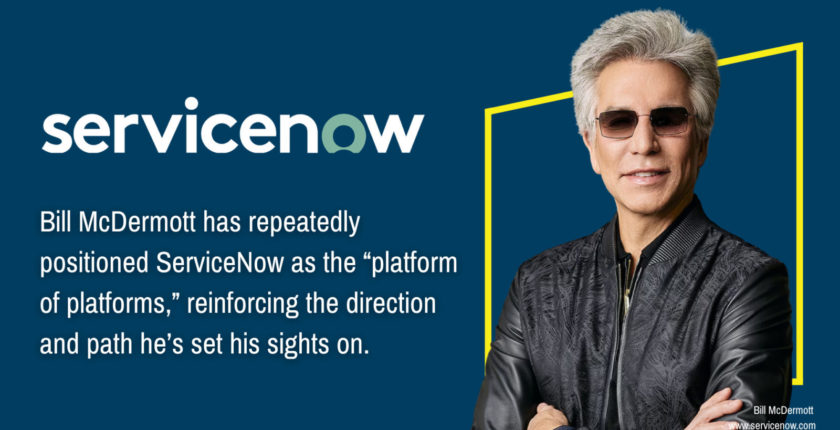
Bill McDermott has repeatedly positioned ServiceNow as the “platform of platforms,” reinforcing the direction and path he’s set his sights on.
In many ways, ServiceNow is evolving into the operating system for enterprise work. It’s not interested in replacing systems, but coordinating the ways in which work flows between them.
2. The ServiceNow Platform Will Manage an AI Workforce
The conversation around AI has progressed to more advanced means than copilots and assistants.
We are now entering a phase where AI agents can execute tasks autonomously within enterprise environments. Companies are already supplementing their staff with digital worker bots and AI powered tools.
IBM and Microsoft are both investing heavily in autonomous AI agents capable of performing multi-step business processes, while ServiceNow itself has introduced AI agents within its platform ecosystem.
At scale, businesses could soon be managing thousands of AI agents embedded within workflows.
These agents will perform a whole host of tasks, including:
- Resolving incidents
- Processing service requests
- Provision infrastructure
- Managing HR workflows
- Executing operational decisions
While the capabilities will be (and are) present, this now introduces a new challenge: governance.
According to Deloitte, one of the biggest barriers to enterprise AI adoption is not capability, but control. It’s now much more of a consideration how businesses monitor, manage, and trust these autonomous systems that are growing more capable by the day.
The concept of the Autonomous Enterprise, increasingly discussed by industry leaders, points to a future where companies manage two workforces: human employees and AI agents.
ServiceNow has uniquely positioned itself to be able to orchestrate both.
3. The ServiceNow Talent Market Will Radically Shift
With every major platform shift comes a talent shift, and ServiceNow will be no exception.
Historically, the ecosystem has been driven by implementation-focused roles, from developers and configurators to technical consultants and architects. But this model is already evolving.
As AI becomes embedded into workflows, businesses need a different type of expertise. One that combines technology with strategy and ops.
According to UK Government data, jobs involving AI are projected to reach 12% of the workforce (3.9 million people) by 2035, accelerating demand for higher-level, cross-functional capabilities.
Within the ServiceNow ecosystem, this translates to the growing demand for professionals who understand:
- Workflow orchestration across complex environments
- AI governance and risk management
- Enterprise platform architecture
- End-to-end automation strategy
Because right now, we’re already seeing a shift towards AI-enabled ServiceNow architects, platform transformation leaders, and enterprise automation specialists. These were skills that wouldn’t have even been thought about 3–5 years ago.
The market is now moving up the value chain.
The most in-demand individuals will define how the ServiceNow ecosystem operates across the enterprise.
ServiceNow Is Playing to Win
In its first era, ServiceNow digitised enterprise workflows. The second era automated them. And now, the next era will see AI agents executing work across the enterprise.
The businesses that master how to govern that autonomous workforce will define the next generation of enterprise transformation. And this isn’t a distant future. It’s already starting to play out.
It’s an exciting time for the industry, especially when you step back and look at the acquisitions they’ve been making recently.